Key takeaways
- Group BIa means water absorption ≤ 0.5 percent — that is the definition, not a marketing claim.
- Low absorption addresses frost and staining, not the structural questions large formats raise.
- Substrate flatness becomes critical as format increases.
- Facade use above low levels usually means mechanical fixing or an adhesive system with safety anchors.
What it is
Porcelain slabs are dry-pressed ceramic panels fired to a dense, largely vitrified body. The term is defined rather than descriptive: under ISO 13006 and its European equivalent EN 14411, porcelain is Group BIa — dry-pressed tile with water absorption of no more than 0.5 percent by mass.
That single number is what separates porcelain from other ceramics in the same standard, and it is worth asking for on a datasheet rather than accepting “porcelain” as a description.
What low absorption buys
Density at that level means very little water is taken up, which is why porcelain is used in frost-prone exposure and in positions where staining would otherwise be a problem. It is also why the material itself is not usually the limiting factor on a facade.
What low absorption does not solve
Everything that large format introduces:
Substrate flatness becomes critical. A deviation that a 300 mm tile bridges will telegraph or cause voids under a slab several times that size, and voids under a large panel are both an appearance and a durability problem.
Handling changes. Large slabs need suction-cup frames and more people, and they break differently from small tiles — usually during handling rather than in service.
Bedding coverage matters more. Back-buttering and full coverage go from good practice to requirement as format increases, because the consequences of a void scale with the panel.
Fixing on facades is a system decision. Above low levels, adhesive alone is generally not the answer; mechanical fixing systems, or adhesive systems supplemented with safety anchors, are specified according to height and exposure.
Common formats
Standard-format tiles, large-format slabs, and reduced-thickness panels intended to cut weight. Thin panels are frequently supplied with a reinforcing backing, which changes both the cutting method and the fixing options — it is a different product, not just a thinner one.
Advantages
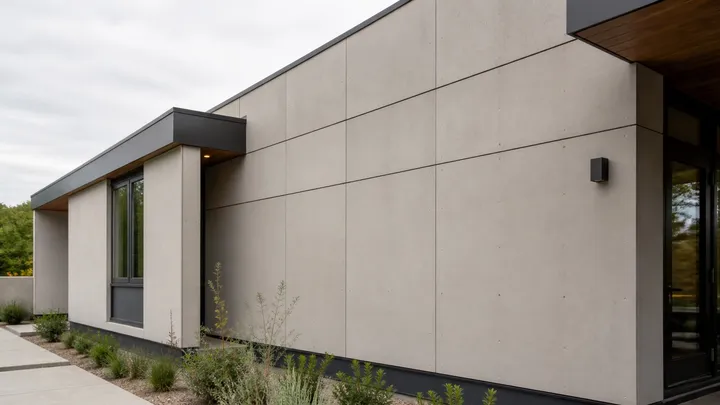
Very low absorption, high resistance to staining and abrasion, and a surface that does not need sealing in the way absorptive natural stones can. Large formats give continuous surfaces with few joints, which is the main reason they are chosen over quarried stone for a contemporary facade.
Limitations
Handling and substrate demands scale with format. Cutting requires the right tooling, and site modification is less forgiving than with smaller units. And the facade fixing question adds cost that does not appear when comparing material prices alone.
Installation overview
Substrate assessment against the adhesive manufacturer’s flatness tolerance, then the specified bedding with full coverage, movement joints per the system, and — on facades above low levels — the mechanical or anchored system the height requires. On external work the adhesive has to be rated for exterior exposure and for the thermal cycling the wall will see.
Maintenance
Cleaning, plus inspection of joints and sealant. The slab surface itself is largely maintenance-free; the joints and the fixing system are what get inspected.
Selection checklist
- Is the product confirmed as Group BIa under ISO 13006 or EN 14411, with the absorption figure stated?
- Does the substrate meet the adhesive manufacturer’s flatness tolerance for this format?
- For facade use, what fixing system is specified for the height and exposure?
- Is full bedding coverage specified, and is back-buttering required?
- Is the adhesive rated for exterior exposure and thermal cycling?
For the comparison against quarried stone, see Porcelain Slab vs Natural Stone; explore how it ranks among the best materials for exterior walls; and for the other options, browse wall cladding.
Key performance characteristics
| Property | Typical range | Basis |
|---|---|---|
| Classification | Group BIa under ISO 13006 and EN 14411 — dry-pressed with water absorption Ev no more than 0.5 percent | ISO 13006 group definition |
| Water absorption | no more than 0.5 percent by mass for Group BIa This is the defining property of porcelain within the ceramic classification. | ISO 13006 |
| Frost behaviour | low absorption makes frost-prone exposure feasible; confirm the specific product and system | — |
| Format and thickness | varies widely from standard tile to large slabs and reduced-thickness panels Format drives handling, substrate tolerance and fixing method more than material properties do. | — |
| Facade fixing | depends on height and system; mechanical fixing or adhesive with safety anchors is common above low levels | — |
Ranges are indicative and vary by product formulation, grade and thickness. Confirm values against the current manufacturer documentation for the product actually being supplied, and verify the applicable local codes.
Compared with alternatives
- Porcelain Slab vs Natural Stone Large-format porcelain slabs and natural stone veneer compared on absorption, format, fixing method, damage behaviour and what each costs beyond the material.
Frequently asked questions
What actually makes a tile porcelain?
The classification. Under ISO 13006 and EN 14411, Group BIa is dry-pressed ceramic with water absorption of 0.5 percent or less. It is a measured property, not a description of appearance.
Can porcelain slabs be used on a facade?
Yes, but the fixing method is the question rather than the material. Above low levels this normally means a mechanical fixing system, or an adhesive system with safety anchors, specified for the height and exposure.
Sources
- ISO 13006 — Ceramic tiles: definitions, classification, characteristics and marking — ISO Accessed August 28, 2026.
- Porcelain vs. non-porcelain: how the classification is applied — Tile Council of North America Accessed August 28, 2026.
- How to avoid tile failure by choosing the right tile adhesive — Wacker Accessed August 28, 2026.